If you would like to read something listed here but do not have library access, please contact me using this website.
Journal Articles
Baptism and Confirmation? A Possibility for Reconciling the Book of Common Prayer 1979’s Rites (2025)
Abstract: In this paper I suggest that a distinctively Protestant reclamation of the concept that confirmation can be a component of Christian sanctification could help clarify its place and present form in the BCP. More specifically, I synthesize an Anglican account of baptismal regeneration with Andrew Torrance’s recent work to describe accountability as a theological virtue in order to suggest that baptism pertains to justification, as understood according to the classical Protestant ordo salutis, while confirmation pertains to sanctification. In this way, the two rites can be teased apart as they are in the BCP with denigrating or sacrificing either of them for the sake of the other.
Published in Anglican Theological Review.
The Moderated Ecumenical Interpretation of the Atonement (2025)
Abstract: In this paper I contend that a rapprochement between Eleonore Stump and William Lane Craig’s views of the atonement is possible. In fact, such a union of the two can ameliorate difficulties each faces on its own. Particularly, Stump’s work faces difficulties regarding her “Anselmian” conceptual category, the role of divine justice in atonement, and the “stain on the soul” while Craig seems to overly bifurcate justification from sanctification and neglect divine love. These problems can be addressed using the resources each can provide the other, resulting in a synthetic account that benefits from what Stump and Craig respectively offer. Moreover, this account can engage common concerns from both Catholic and Protestant views of the atonement in turn, thereby offering a distinctively ecumenical position as well. In light of both of these aspects of its construction, this model is here called “the moderated ecumenical interpretation of the atonement” or “MEI.”
Published in Kerygma und Dogma: Zeitschrift für theologische Forschung und kirchliche Lehre.
Felony Murder and Legal Analogies for Penal Substitution (2025)
Abstract: In this brief paper I suggest that a way William Lane Craig’s account of penal substitutionary atonement (PSA) can dodge a conceptual issue posed by Oliver Crisp – here called the Crisp’s concern – is via appeal to the felony murder rule. In order to do this, I first recapitulate some relevant details from Craig’s account before offering a sketch of how felony murder might be added to his ensemble of legal analogies for PSA. However, I then point out two issues this approach could bring with it: namely, that the solution may be more trouble than it is worth for Craig and that, depending on how one thinks contemporary applications of the felony murder rule came to be, it might not actually be a helpful concept in the first place. So, I conclude by proposing that the best way for Craig to avoid the Crisp’s concern might actually be to either revise his view of retributivism or become a non-necessitarian about the atonement.
Published in Philosophia Christi: The Journal of the Evangelical Philosophical Society.
Hopeful Universalism and the Goodness of God: A Fittingness Approach (2025)
Abstract: Is hopeful universalism a coherent belief for a Christian to hold? Recent criticism of the view has suggested it may not be. Most incisively, Michael Rea has highlighted how hopeful universalism seems to require a Christian to desire a state of affairs “that conflicts with what she believes to be the perfectly good will of God.” While there are versions of the view which are guilty of exactly what Rea alleges, it is not necessary for the hopeful universalist to hold to them. Particularly, hopeful universalism can be understood to consist in a fittingness claim about one’s understanding of God’s will which requires no desires in conflict with said will. So, in this paper I argue for such a position, here termed “fittingness hopeful universalism” (FHU). I begin by sketching Rea’s critique to outline what we aim to avoid here. Next, I offer a brief survey of universalism’s place in theological history to highlight why Christians might prefer hopeful universalism to a more dogmatic version of the view. I then construct FHU to demonstrate one way Christians can avoid the problem Rea highlights while heeding historical theological norms. Finally, I anticipate and respond to two potential objections. Namely, that universalism and non-universalism cannot be co-equal goods, and that the co-equality of universalism and non-universalism would undermine divine goodness.
Published in the International Journal for Philosophy of Religion.
Time to be saved? Parousia, Purgation, and Psychological Time Dilation (2025)
Abstract: James Turner has argued that views of purgatorial post-mortem salvation face a dilemma on the basis of their motivating intuitions vis-à-vis the second coming of Jesus (i.e., the parousia). Namely, they can accept that some persons experience “abrupt purgation” (undermining a key reason for affirming purgation), they can posit all who are not already saved at the second coming are damned (a view which is highly distasteful to purgatory advocates), or they can deny the parousia (a position which is unorthodox). I offer a way of defusing this problem by constructing a second-chance soteriology on which persons in post-mortem purgation experience a state of psychological time dilation. In so doing, I first articulate the problem at hand before turning to relevant examples from fictional media and the neuropsychology of dreaming to support my constructive efforts. Finally, I apply this solution to a pre-existing soteriological model which already uses such resources so as to demonstrate its usefulness: namely, my own compassionate exclusivist view.
Published (open access) in Agatheos: European Journal for Philosophy of Religion.
Horizons of Hope: Disability, Eschatology, and the Work of the Holy Spirit (2024)
Abstract: In this paper I propose a model of disability which synthesizes Amos Yong’s disability theology with Elizabeth Barnes’s “value-neutral model” of disability and then draws Sarah Coakley’s account of ante-mortem/post-mortem bodily fluidity in with both. To construct this model, I first outline Yong’s thought and then introduce Barnes’s work to it as a pivot point around which its eschatological imagery can turn. I then address Coakley’s work on bodily fluidity regarding gender and apply it to disability to reveal the model’s capacity to hold theological clarity and mystery in tension successfully.
Published (open access) in the Journal of Disability & Religion.
Analytic theology (2023)
Abstract: Analytic theology is often described as something like the application of analytic philosophy’s tools to theological studies, but what this means can be unclear. In this paper, I offer a primer on analytic theology which clarifies this common description of the field. Particularly, following Sarah Coakley, I sketch an account of analytic theology on which it consists of a relation of familial resemblance. That is, analytic theologians are those who investigate theological loci in ways akin to those seen in contemporary analytic philosophy. In so doing, I also briefly describe how analytic theology is conceptually distinct from both philosophical theology and analytic philosophy of religion. I then provide a threefold typology for understanding analytic theology’s literary landscape whereby its practitioners can generally be understood to produce works which are either philosophically-inclined, theologically-inclined, or mixed in their inclination. Finally, I offer a brief survey of new frontiers being explored by analytic theologians.
Published (open access) in Religion Compass.
“Draw Me After You:” Toward an Erotic Theosis (2023)
Abstract: In this article I propose an erotic theosis as a fruitful possibility for conceptualising our final participation in union with God in the beatific vision and for imaging said participation on earth. Particularly, I propose a synthesis of recent work from Oliver Crisp on theosis with that of Sarah Coakley on sexual desire as an especially helpful way in which to conceive of our ever-deepening participation in God’s love. Further, this synthesis uses contributions from Erin Dufault-Hunter on the intersections of sexual desire and ethics as a catalyst for its recommendations.
Published (open access) in the Scottish Journal of Theology.
Making and Mending Our Selves: A Practical Proposal (2022)
Abstract: Theological anthropology has tended to view human flourishing as consisting in the loving communion of our selves with God. Recently, Natalia Marandiuc has brought the tools of attachment theory to theological anthropology to argue that a self is not inherent to human persons but rather is co-created through our loving relationships with one another and with God. In this paper I argue for the introduction of narrative, particularly as understood through the work of Eleonore Stump, to Marandiuc’s account as a practical means by which healing love might be communicated, particularly through Scriptural narratives. In evidence of narrative’s usefulness, I offer a brief exegesis of the Gospel of John’s account of the Woman at the well. This synthesis fills a gap in our understanding of the self’s flourishing by not only adopting a model demonstrating its emergence but also by providing a method by which the model can be applied.
Published (open access) in TheoLogica: An International Journal for Philosophy of Religion and Philosophical Theology.
Compassionate Exclusivism: Relational Atonement and Post-Mortem Salvation (2021)
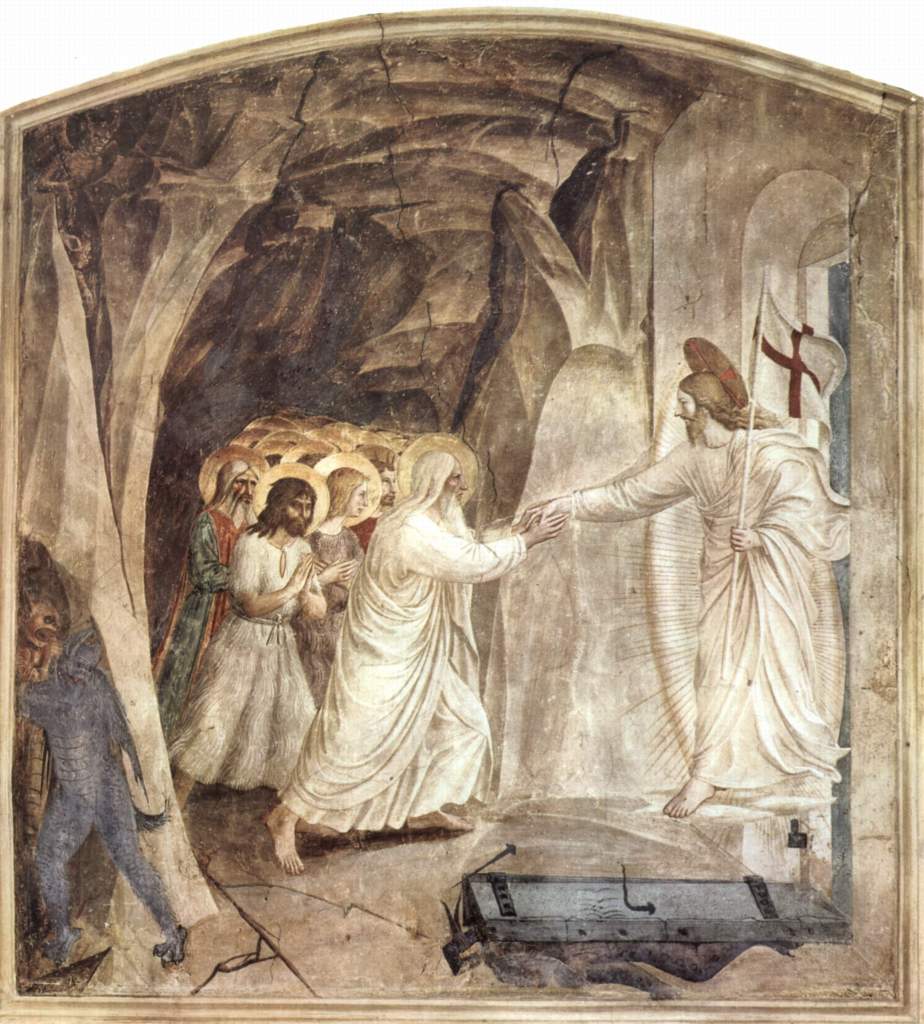
Abstract: Faithful persons tend to relate to their religious beliefs as truth claims, particularly inasmuch as their beliefs have soteriological implications for those of different religions. For Christians the particular claims which matter most in this regard are those made by Jesus of Nazareth and his claims are primarily relational in nature. I propose a model in which we understand divine grace from Jesus as being mediated through relational knowledge of him on a compassionately exclusivist basis, including post-mortem. Supporting this model, I draw from Eleonore Stump’s hypothesis in her 2018 Atonement that the crucifixion of Jesus opens the divine psyche to all human psyches sufficiently for salvific mutual indwelling to occur, and from Gavin D’Costa’s conception of the descensus Christi ad inferos as the mechanism for grace’s accessibility post-mortem presented in his 2009 Christianity and World Religions. This model seeks to address ongoing, justified pastoral concern for the soteriological status of non-Christians while still treating Christianity as objectively true.
Published (open access) in the Journal of Analytic Theology.
Book Chapters
Scripture and Atonement (forthcoming)
Forthcoming in the T&T Clark Encyclopedia of Christian Theology (T&T Clark)
Justification by Faith? Lessons from Profound Cognitive Disability (forthcoming)
Forthcoming in Recieving Redemption: Explorations in Constructive Dogmatics (Zondervan Academic).
Disability, Eschatology, and Sword Art Online (2025)
In David Armstrong and Roberto J. De La Noval (eds.), Anime, Religion, and Theology (Lexington Books/Fortress Academic, 2025).
A Theory of Well-Being for Disability Theology (2025)
In Preston McDaniel Hill and Aaron Brian Davis (eds.), Disability Theology and Eschatology: Hope, Justice, and Flourishing (Lexington Books, 2025), 17-48.
 aaronbdavis.com